
Sentinels – A vital tree network

Citizen Science Officer for Observatree - Woodland Trust
This National Tree Week, we’re shining a spotlight on the East Midlands- home to some of our dedicated Observatree volunteers and their favourite sentinel trees. These fantastic observers have already submitted an incredible 655 reports this year, making the region our most active hub for sentinel monitoring. But what makes these trees so special, and why do they matter so much? Let’s find out…
Matt Parratt, our Scientific Coordinator for Observatree, puts it best:
“Usually used in a military setting, a sentinel is one who watches or guards, specifically a soldier set to guard a place from surprise, to observe the approach of danger and give notice of it. In the context of trees, a sentinel is one which is deliberately selected for regular repeated monitoring for signs of ill-health. Each time we visit the tree, we make a standard set of observations and compare them to the preceding visit and build up a longer-term picture over time. This gives us both an early warning network against tree pests and diseases and helps us to learn how trees respond to novel pests and diseases over time.
So why do we need sentinel trees? There are an estimated 3 billion trees in the UK, and it would be impossible to monitor every one of them for signs of pests and diseases. Instead, the UK uses a range of monitoring methods which combine to give the best chance of intercepting potential problems, and these include helicopter and drone surveys, the Forest Trapping Network, Port Inspections, and Observatree sentinel tree surveys.”
Now let’s look at some trees! Here are Sue's favourites…
A Sycamore on Cromford Meadows

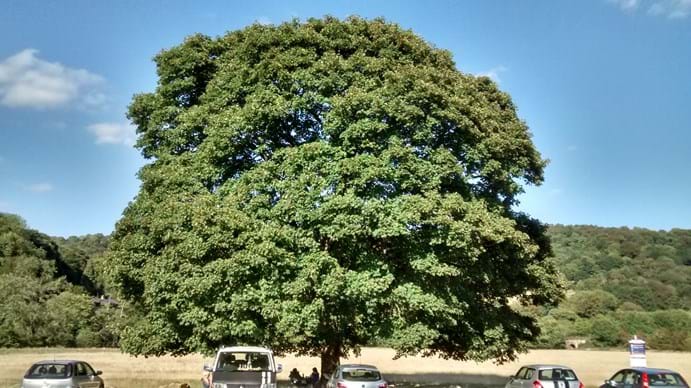

“This tree was one of my first sentinels, and I had monitored it since the beginning of the project, before sentinels were an established method. It has the grace and presence of a beautiful middle-aged tree. It also shows its beautiful shape, typical of this species, through all seasons.' I attach: 3 photos leaf-on season over time 2014, 2018, 2024.”
A Sweet Chestnut at Whitworth Park


“This tree stands proud beside the main path through the park. It bears an amazing amount of fruit and in recent years has many epicormic shoots. I love the shape of the trunk with all its irregularities and the irregular shape of the crown as it ages. Photos 2017, 2020, 2025.”
Time for some Oaks! Here Paul shares with us his favourite trees…
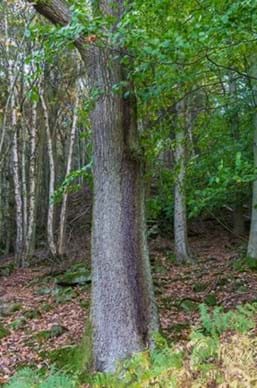
“Both these trees are sessile oak trees, and I have visited one for 7 years, and one for 8 years. They are particularly special to me because, when first reported, they both looked as though they were beginning a decline. Not only have both survived, but they look healthier now than they did at the beginning.”
Oak Number 1


“I noticed a series of bleeds on the stem of this tree, reported it on TreeAlert, and was asked by Forest Research to take swabs of the bleeds. The initial swabs were suspicious of Acute Oak Decline, but not diagnostic. A year later, after a period of excessive rain, followed by a drought, the bleeds were more obvious, and I sent further swabs, from which were isolated three different bacteria associated with Acute Oak Decline. Forest Research confirmed the diagnosis of Acute Oak Decline, despite the apparent lack of D-shaped exit holes (after numerous visits, I finally identified a D-shaped exit hole). The good news is that the tree appears to be responding to the Acute Oak Decline: the bleeds have become gradually less active over the years, have been dry for at least 2 years, and are gradually fading. The epicormics around the base of the stem, a feature in 2019, have stopped growing, suggesting that the tree is less stressed. From a distance, the tree looks healthy and is producing a good crop of fruit each year.”
Oak Number 2

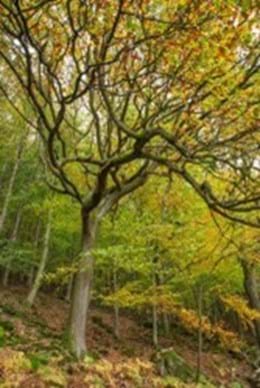
“On a family walk, I noticed that this tree had an enormous wet weep down it’s stem. I was fairly new to Observatree and was concerned that this may be Acute Oak Decline. I reported on TreeAlert and was reassured that this was not typical of Acute Oak Decline but may be a slime flux (bacterial wet wood). The stem was wet to the touch and somewhat slimy in consistency. I have followed this tree and am happy to report that it continues to thrive, the long weep line has become progressively drier and less prominent and currently does not appear to be adversely affecting the tree.”
Our volunteers show just how vital sentinel trees are in protecting the UK’s treescape. Through their dedication and careful monitoring, we gain early warnings of pests and diseases and build a deeper understanding of how trees respond to environmental challenges over time. Every report, every observation, and every photo helps safeguard the health of our woodlands for future generations. So, as we celebrate National Tree Week, let’s take a moment to appreciate not only the beauty of these sentinel trees but also the incredible commitment of the volunteers who watch over them. Together, we’re making a real difference for the trees we love.
Special thank you to Sue & Paul, our Lead Volunteers in the East Midlands, for sharing their trees with us.